We are happy to announce that our latest book project will be available this summer. Our third book this year….
The Caribb-ican Table
By Michael Bennett
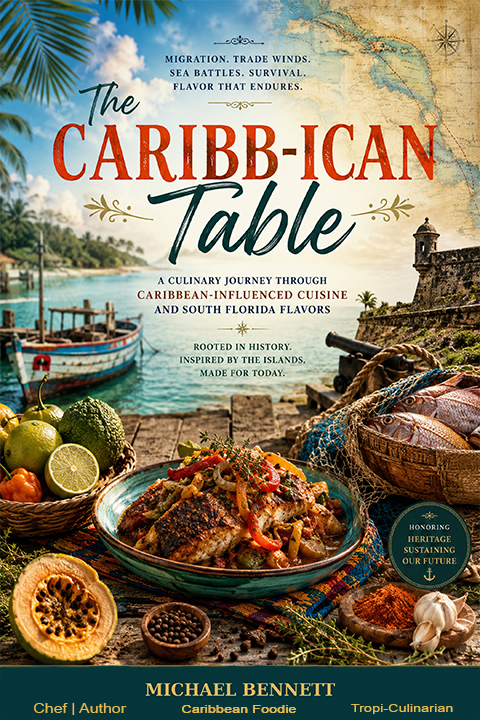
What happens when centuries of migration, trade, conquest, survival, and creativity collide in one of the most beautiful regions on earth?
In The Caribb-ican Table, award-winning chef, culinary educator, and author Michael Bennett takes readers far beyond recipes and into the living history of Caribbean cuisine. Drawing upon more than fifty years behind professional stoves, decades of culinary writing, and extensive work throughout South Florida and the Caribbean Basin, Bennett explores how the islands developed one of the world’s most diverse and adaptive food cultures.
This is not simply a cookbook. It is a culinary journey through the forces that shaped Caribbean food: Indigenous agriculture, African ingenuity, European colonial influence, Asian migration, tropical climates, fishing traditions, trade winds, and the constant challenge of feeding communities in hot, remote island environments. Readers discover why Caribbean cuisine evolved differently from European cooking, how ingredients became solutions to environmental challenges, and why tropical food systems remain remarkably relevant to modern health-conscious dining.
Through engaging stories, historical insights, chef-driven observations, and practical recipes, Bennett demonstrates how Caribbean cooks transformed necessity into culinary brilliance. The book examines everything from warm-water seafood handling and acid-driven flavor architecture to preservation techniques, tropical agriculture, pepper systems, legumes, fruit cookery, and the philosophy behind cooking for climate.
Building upon themes first introduced in Bennett’s acclaimed book The Floridian Table, The Caribb-ican Table reveals the deep connections between Florida and the Caribbean while defining a broader culinary framework that Bennett calls “Caribb-ican Cookery”—a modern interpretation of tropical cuisine that respects history while embracing contemporary techniques and healthy Mediterranean-inspired principles.
Whether you are a professional chef, culinary student, food historian, serious home cook, or simply someone fascinated by the stories behind great food, The Caribb-ican Table offers a fresh perspective on one of the world’s most influential yet often misunderstood regional cuisines.
Rich with culinary scholarship, practical wisdom, and the passion of a lifetime devoted to food, this book explains not only how Caribbean food is prepared—but why it became one of the most resilient, flavorful, and culturally significant cuisines in the world.
The Caribb-ican Table is an exploration of history, flavor, climate, culture, and identity—served one story, one ingredient, and one recipe at a time.
220 pages, soon available at all retailers.
The Caribb-ican Table
One Sea, One Table: How the Caribbean Rewrote Florida’s Kitchen
For more than fifty years, award-winning chef, culinary educator, and author Michael Bennett has explored one question that few have asked with any depth:
Why does Florida taste the way it does?
The answer, he argues, has never been found solely within Florida’s borders.
It has always been carried across warm water.
In The Caribb-ican Table, Bennett takes readers on a remarkable culinary journey that reveals how the islands of the Caribbean quietly transformed the food culture of Florida. This is not simply another cookbook or a collection of tropical recipes. It is an exploration of history, climate, migration, agriculture, and professional cookery—showing how geography became one of the greatest chefs the world has ever known.
Long before culinary schools attempted to define regional American cuisine, the Caribbean was solving problems that every tropical cook would eventually face. Intense heat demanded lighter sauces. Limited refrigeration encouraged preservation through fermentation, citrus, salt, and spice. Fresh seafood required balance rather than heaviness. Tropical agriculture produced ingredients unlike those found anywhere else in North America. These realities shaped an entirely different philosophy of cooking—one based on freshness, acidity, restraint, and respect for the environment.
Those ideas crossed the water with fishermen, merchants, immigrants, and families seeking new opportunities. They arrived in Key West, Miami, Palm Beach, and every coastal community connected by the same sea, the same prevailing winds, and the same relentless subtropical climate.
Florida did not simply borrow Caribbean recipes.
It inherited Caribbean ways of thinking.
Throughout this book, Bennett demonstrates how ingredients such as mango, lime, tamarind, coconut, pigeon peas, Scotch bonnet peppers, aji dulce, tropical herbs, and warm-water seafood evolved from simple island staples into the foundation of one of America’s most exciting regional cuisines. Readers discover why acid often replaces cream, why fermented peppers can perform the work of classical French sauces, why tropical fruit provides structure instead of sweetness, and why climate itself determines how great food should taste.
Drawing upon more than five decades behind professional stoves, decades as a culinary writer, and years spent studying both Florida and Caribbean foodways, Bennett introduces his philosophy of Caribb-ican cookery—a culinary perspective recognizing that Florida and the Caribbean are inseparable partners in the evolution of modern tropical cuisine.
The book explores:
- How migration, trade, and colonial history shaped Caribbean kitchens.
- Why warm-water seafood requires a completely different culinary approach.
- The influence of Miami as the crossroads where Caribbean cultures continue to redefine American dining.
- The development of acid-driven flavor architecture instead of fat-driven cooking.
- Fermentation, preservation, and tropical pantry systems.
- Sustainable seafood practices and climate-conscious menu development.
- The continuing evolution of modern Florida cuisine through Caribbean influence.
Alongside these stories are thoughtfully developed recipes that demonstrate the principles behind the philosophy. Each dish illustrates not only how to cook but why generations of Caribbean cooks developed these techniques in the first place.
At its heart, The Caribb-ican Table argues that cuisines are living systems. They are shaped by weather, geography, necessity, migration, and the continual exchange of ideas. The Caribbean did not merely influence Florida—it helped define it. Every plate of citrus-marinated seafood, every mango-glazed fish, every pepper sauce layered with fermented complexity tells a story that began centuries ago and continues today in kitchens throughout the Sunshine State.
This volume also serves as the natural companion to Bennett’s acclaimed Florida Cuisine Collection, including The Floridian Table, Interview with a Mango, Flavor Quest, Underneath a Cloudless Sky, and All-Natural Surf Cuisine. Together these works document the evolution of modern tropical American cookery through the eyes of one of its lifelong practitioners.
The Caribb-ican Table invites readers to look beyond recipes and discover the larger story of flavor itself—a story written not by borders, but by currents, climates, cultures, and generations of cooks who transformed necessity into culinary brilliance.
The story was never Florida versus the Caribbean.
It has always been Florida and the Caribbean.
One sea.
One climate.
One conversation.
One table.
Pull up a chair.
The Caribb-ican Table has been waiting for you.


Leave a Reply